


- Overview
-
- Commodity name: Sewage treatment equipment for highway service areas
The domestic sewage treatment equipment for expressway service areas adopts the A/O (Anoxic/Oxic) biological treatment process.
Product Introduction
The domestic sewage treatment equipment for expressway service areas adopts the A/O (Anoxic/Oxic) biological treatment process.
-
Anoxic Stage (A-Stage): This stage utilizes anoxic biological treatment. Facultative microorganisms use organic carbon sources as electron donors to convert NO₂-N (nitrite nitrogen) and NO₃-N (nitrate nitrogen) in sewage into N₂ (nitrogen gas), achieving the goal of nitrogen removal. This eliminates nitrogen-induced eutrophication pollution while removing part of the organic matter.


-
Oxic Stage (O-Stage): This stage employs aerobic biological treatment to further oxidize and decompose organic matter. Meanwhile, when carbonization tends to be completed, nitrification can proceed smoothly. The O-Stage tank mainly contains aerobic microorganisms and autotrophic bacteria (nitrifying bacteria). Aerobic microorganisms decompose organic matter into CO₂ (carbon dioxide) and H₂O (water); autotrophic bacteria (nitrifying bacteria) convert NH₃-N (ammonia nitrogen) in sewage into NO₂-N and NO₃-N. A portion of the effluent from the O-Stage tank is recycled back to the A-Stage tank to provide electron acceptors for the A-Stage, ultimately eliminating nitrogen pollution through nitrification.
Design Features
-
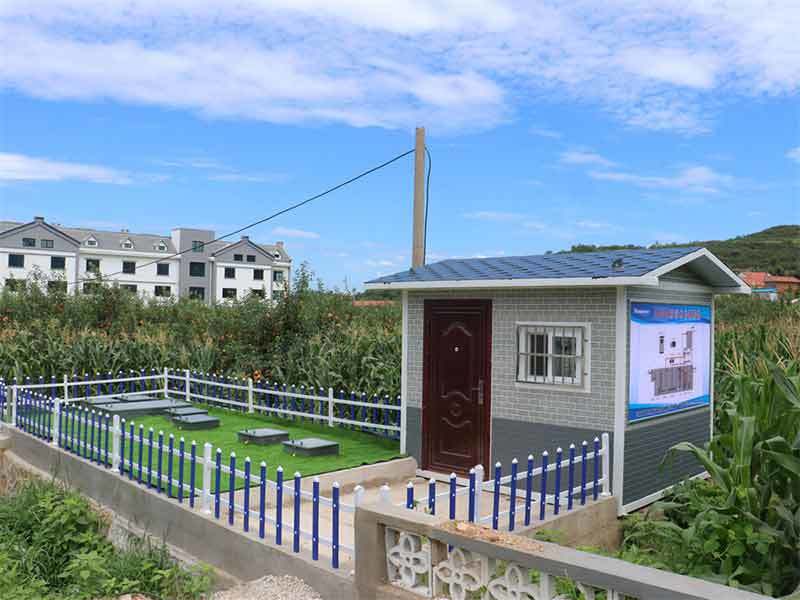
The MJC series domestic sewage treatment equipment is buried underground. The ground surface above the equipment can be used for greening or other purposes, eliminating the need for constructing houses, heating, or thermal insulation.
-
The A/O biological treatment process adopts plug-flow biological contact oxidation, whose treatment effect is better than that of completely mixed biological contact oxidation tanks or two-stage/three-stage series completely mixed biological contact oxidation tanks. Compared with activated sludge tanks, it has a smaller volume, stronger adaptability to water quality, better shock load resistance, stable effluent quality, and no sludge bulking. The tank is equipped with new-type elastic three-dimensional fillers, which have a large specific surface area—facilitating microbial biofilm formation and detachment. Under the same organic load, it achieves a high organic matter removal rate and improves the solubility of oxygen from the air in water.
-
The A/O tank adopts biological contact oxidation. The volume load of its fillers is relatively low, and microorganisms are in the self-oxidation stage, resulting in minimal sludge production. Sludge only needs to be discharged once every three months (90 days or more) (via suction and transportation by a manure truck).
-
In addition to conventional noise reduction measures (such as vibration isolation pads and silencers) for the blower, a sound attenuation device is installed at the entrance of the blower room. This ensures the equipment’s operating noise is below 50 decibels (A-weighted), meeting the requirements for quiet residential areas and causing basically no impact on the surrounding environment.
-
For deodorization, the buried domestic sewage treatment equipment not only uses conventional high-altitude exhaust but also is equipped with soil deodorization measures.
-
The entire equipment treatment system is equipped with a fully automatic electrical control system and an equipment fault alarm system, ensuring safe and reliable operation. Generally, no full-time personnel are required for daily management—only timely maintenance and upkeep of the equipment are needed.
Keywords:
Messages

Contact: +86 18016210178 (Ms.Liu)
Add:No.56, Donghuan Road, Zhucheng City, Weifang City, Shandong Province