


Belt filter press
Category
零售价
市场价
重量
库存
隐藏域元素占位
- Overview
-
- Commodity name: Belt filter press
This machine is suitable for sludge dehydration in the wastewater treatment processes of urban sewage treatment plants, pharmaceutical, electroplating, papermaking, leather, printing and dyeing, metallurgy, chemical engineering, slaughtering, food, brewing, coal washing, and environmental protection projects. It can also be used for solid-liquid separation in industrial production, making it an ideal equipment for environmental governance and resource recovery.
Structural Features of Belt Filter Press
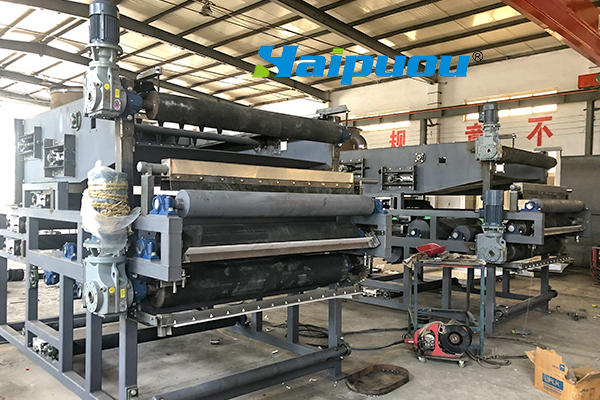
The Haipou belt filter press features a compact structure, novel design, convenient operation and management, large processing capacity, low moisture content in filter cakes, and excellent performance. Compared with similar equipment, it has the following characteristics:
-
The first gravity dehydration section is inclined, allowing the sludge to be as high as 1700mm from the ground. This increases the height of the sludge in the gravity dehydration section and improves the gravity dehydration capacity.
-
The gravity dehydration section has a long length—the total length of the first and second gravity dehydration sections exceeds 5 meters—ensuring that the sludge is fully dehydrated and loses fluidity before pressing. Meanwhile, the gravity dehydration section is also equipped with special mechanisms such as reverse rotation. Through the effects of "wedge"-shaped and "S"-shaped pressing, the sludge filter cake achieves a low moisture content.
-
The first dehydration roller adopts a "T"-shaped water discharge groove, which enables rapid discharge of a large amount of water after pressing, thereby improving the dehydration effect.
-
Automatic control devices are installed for issues such as filter belt deviation. The filter belt tension and filter belt moving speed can be adjusted freely, facilitating operation and management.
-
Low noise and no vibration.
-
Low consumption of chemical agents.
Applications
This machine is suitable for sludge dehydration in the wastewater treatment processes of urban sewage treatment plants, pharmaceutical, electroplating, papermaking, leather, printing and dyeing, metallurgy, chemical engineering, slaughtering, food, brewing, coal washing, and environmental protection projects. It can also be used for solid-liquid separation in industrial production, making it an ideal equipment for environmental governance and resource recovery.
Keywords:
Messages

Contact: +86 18016210178 (Ms.Liu)
Add:No.56, Donghuan Road, Zhucheng City, Weifang City, Shandong Province