


MVR forced circulation evaporator
Category
零售价
市场价
重量
库存
隐藏域元素占位
- Overview
-
- Commodity name: MVR forced circulation evaporator
MVR is the abbreviation of Mechanical Vapor Recompression technology. The MVR evaporator is an energy-saving technology that can reuse the energy of secondary vapor generated by itself, thereby reducing the demand for external energy sources. The working process of MVR is as follows: A compressor compresses low-temperature-level vapor to increase its temperature, pressure, and heat content. The compressed vapor then enters a heat exchanger for condensation, enabling full utilization of the latent heat of the vapor. Except for the start-up phase, no additional steam needs to be generated for the secondary vapor of the evaporator throughout the entire evaporation process. After being compressed by the compressor, the vapor’s pressure and temperature rise, and its heat content increases. It is then sent to the heating chamber of the evaporator to serve as heating steam, which keeps the feed liquid in a boiling state, while the heating steam itself condenses into water. In this way, waste vapor can be fully utilized, latent heat is recovered, and thermal efficiency is improved. The economic efficiency of live steam is equivalent to that of a 30-effect multi-effect evaporation system. To make the manufacturing of the evaporation device as simple as possible and its operation convenient, high-pressure fans and high-pressure blowers can be used. These machines have a relatively high volumetric flow rate within a compression ratio range of 1:1.2 to 1:2.
1. MVR Principle
MVR is the abbreviation of Mechanical Vapor Recompression technology. The MVR evaporator is an energy-saving technology that can reuse the energy of secondary vapor generated by itself, thereby reducing the demand for external energy sources.
The working process of MVR is as follows: A compressor compresses low-temperature-level vapor to increase its temperature, pressure, and heat content. The compressed vapor then enters a heat exchanger for condensation, enabling full utilization of the latent heat of the vapor. Except for the start-up phase, no additional steam needs to be generated for the secondary vapor of the evaporator throughout the entire evaporation process. After being compressed by the compressor, the vapor’s pressure and temperature rise, and its heat content increases. It is then sent to the heating chamber of the evaporator to serve as heating steam, which keeps the feed liquid in a boiling state, while the heating steam itself condenses into water. In this way, waste vapor can be fully utilized, latent heat is recovered, and thermal efficiency is improved. The economic efficiency of live steam is equivalent to that of a 30-effect multi-effect evaporation system.
To make the manufacturing of the evaporation device as simple as possible and its operation convenient, high-pressure fans and high-pressure blowers can be used. These machines have a relatively high volumetric flow rate within a compression ratio range of 1:1.2 to 1:2.
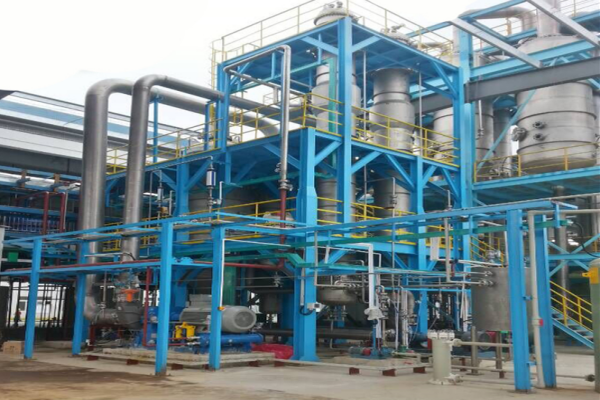
2. MVR Process Flow
The system consists of single-effect or double-effect evaporators, separators, compressors, vacuum pumps, circulating pumps, operating platforms, electrical and instrument control cabinets, valves, pipelines, and other components. It features a simple structure and easy operation and maintenance.
Introduction to Evaporators
MVR Falling Film Evaporator
Working Principle
The feed liquid is added from the channel box of the heat exchanger. A liquid distributor distributes the material into each heat exchange tube, forming a uniform liquid film along the inner wall of the heat exchange tubes. During the downward flow, the liquid film inside the tubes is heated by the heating steam in the shell, and boils and evaporates as it flows downward. At the bottom of the heat exchange tubes, the material is converted into concentrated liquid and secondary vapor.
The concentrated liquid falls into the lower channel box, while the secondary vapor enters the gas-liquid separator. The liquid droplets carried by the secondary vapor are removed in the gas-liquid separator, and the pure secondary vapor is transported from the separator to the compressor. The compressor compresses the secondary vapor, which is then sent to the shell of the heat exchanger as heating steam to act as the heat source for the evaporator, realizing a continuous evaporation process.
Characteristics
- High heat exchange efficiency
- Small floor space
- Short material residence time, which prevents material deterioration
- Suitable for materials with relatively high viscosity
Keywords:
Messages

Contact: +86 18016210178 (Ms.Liu)
Add:No.56, Donghuan Road, Zhucheng City, Weifang City, Shandong Province