

News details
An innovative solution for efficiently addressing decentralized wastewater treatment challenges using integrated wastewater treatment equipment.
Release time:
2025-11-27 15:41
Integrated Sewage Treatment Equipment: Definition, Advantages, Applications, and Trends
Against the backdrop of the continuous improvement of China’s water pollution control system, the challenge of decentralized sewage treatment has gradually become a focus in the environmental protection field. Although the sewage discharge volume from scenarios such as urban residential areas, rural settlements, small and medium-sized enterprises, and medical institutions is not as large as that from large-scale industrial clusters, their characteristics of scattered distribution and complex water quality place higher requirements on the flexibility and efficiency of treatment equipment. As a targeted solution, integrated sewage treatment equipment, leveraging the advantages of integrated design and modular operation, has become a core device to address the dilemma of decentralized sewage treatment.
I. Core Definition and Technical Characteristics of Integrated Sewage Treatment Equipment
Integrated sewage treatment equipment refers to a complete set of equipment that integrates traditional sewage treatment processes (such as grilles, equalization tanks, biochemical reaction tanks, sedimentation tanks, disinfection tanks, etc.) through modular integration to realize the integrated operation of the entire process of sewage collection, treatment, purification, and discharge. Its core technical characteristics are reflected in three aspects:
-
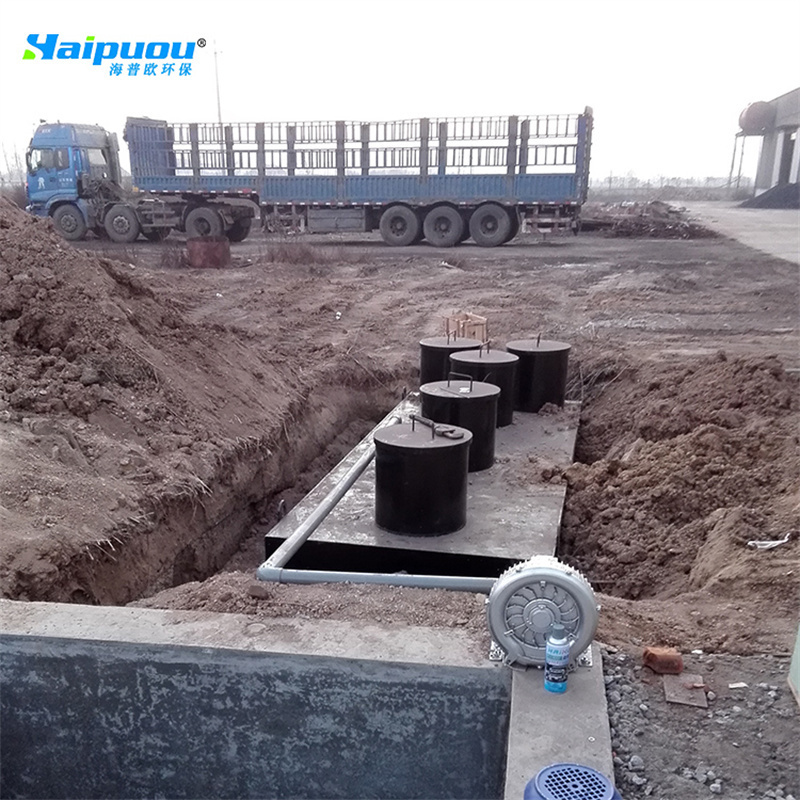
Integrated Design: It breaks through the traditional sewage treatment plant model of "multiple separate tanks and step-by-step treatment" by compressing pre-treatment, biochemical reaction, advanced purification, and other links into a closed box or tank. Its floor area is only 1/3 to 1/5 of that of traditional processes, making it particularly suitable for scenarios with tight land resources such as rural areas, scenic spots, and residential communities.
-
Intelligent Operation: Equipped with a PLC (Programmable Logic Controller) control system, it can real-time monitor key parameters such as incoming water quality, flow rate, and dissolved oxygen, and automatically adjust operating indicators like aeration intensity and sludge return ratio. This reduces manual intervention and lowers operation and maintenance costs. Some high-end equipment also supports remote data transmission to achieve unattended operation.
-
Strong Adaptability: For different water qualities such as domestic sewage, medical wastewater, and food processing wastewater, customized treatment can be achieved by adjusting internal processes (e.g., A/O, SBR, MBR). The effluent quality can stably meet the first-level Class A standard or higher of the Discharge Standard of Pollutants for Municipal Wastewater Treatment Plants (GB18918-2002).
II. Analysis of Core Advantages of Integrated Sewage Treatment Equipment
Compared with traditional sewage treatment models, integrated equipment demonstrates significant advantages in practical applications and has become the preferred solution for decentralized sewage treatment:
-
Convenient Installation and Quick Results: The equipment is prefabricated in the factory. On-site operations only involve foundation pouring, pipeline connection, and circuit debugging. Installation and commissioning can be completed within 3 to 7 days for put-into-use, greatly shortening the project cycle.
-
Low Operation and Maintenance Costs: The modular design reduces equipment maintenance points, and intelligent control optimizes energy consumption (e.g., the aeration system automatically starts and stops based on dissolved oxygen). Costs such as operating electricity fees and chemical agent fees are 20% to 30% lower than those of traditional processes.
-
Low Sludge Production: Adopting biofilm technology or high-efficiency sedimentation technology, the sludge production is only 1/2 of that of the traditional activated sludge process. This reduces the pressure of sludge disposal and avoids secondary pollution.
-
Good Environmental Compatibility: The main body of the equipment can be buried underground or placed on the ground. The underground design does not occupy surface space and can be used for greening or other purposes; ground-mounted equipment adopts noise reduction and deodorization treatments, minimizing impact on the surrounding environment.
III. Typical Application Scenarios of Integrated Sewage Treatment Equipment
With its flexible and efficient characteristics, integrated sewage treatment equipment has been widely applied in multiple fields to meet sewage treatment needs in different scenarios:
-
Rural Domestic Sewage Treatment: Aiming at the characteristics of rural sewage—"small water volume, scattered distribution, and difficult collection"—the equipment can be built for a single village or jointly for multiple villages. The treated water can be used for farmland irrigation or landscape reuse, contributing to rural revitalization and ecological protection.
-
Small and Medium-Sized Urban Communities: In the reconstruction of new urban areas and old residential communities, integrated equipment can serve as a supplement to the municipal pipe network, solving the problem of insufficient pipe network coverage and improving the collection and treatment rate of domestic sewage.
-
Medical and Elderly Care Institutions: In response to the special components of medical wastewater (such as pathogens and disinfectants), the equipment ensures safe effluent that meets the Discharge Standard of Water Pollutants for Medical Institutions (GB18466-2005) through enhanced disinfection (e.g., combined disinfection with ultraviolet rays and chlorine dioxide) and biochemical treatment.
-
Tourist Scenic Spots and Resort Areas: In areas with strict environmental requirements such as nature reserves and scenic spots, the equipment can realize "on-site treatment and discharge up to standard" for sewage, avoiding pollution to ecological landscapes and water sources.
-
Small and Medium-Sized Industrial Enterprises: For low-concentration wastewater from industries such as food processing, slaughtering, and printing and dyeing, the equipment can achieve pre-treatment or up-to-standard discharge through customized processes (e.g., adding air flotation devices and decolorization units) to meet environmental supervision requirements.
IV. Key Points for Selection, Operation, and Maintenance of Integrated Sewage Treatment Equipment
To ensure the long-term stable operation of the equipment, users should pay attention to the following matters during model selection, operation, and maintenance:
-
Accurately Match Treatment Needs: Select the equipment model based on sewage discharge volume (daily average water volume), water quality components (e.g., COD, ammonia nitrogen, total phosphorus concentration), and discharge standards (e.g., first-level Class A, surface water Class IV standard) to avoid "overcapacity" (using a large device for small demand) or insufficient treatment capacity.
-
Focus on Core Materials and Processes: The main equipment is recommended to be made of FRP (Fiberglass Reinforced Plastic), anti-corrosion carbon steel, or 304 stainless steel, which are acid and alkali resistant to extend service life. For core processes, prioritize mature and stable technologies such as A/O and MBR to reduce the risk of later modifications.
-
Attach Importance to Operation and Maintenance Service Capabilities: Choose manufacturers with a sound after-sales system to ensure timely response when equipment malfunctions occur. At the same time, conduct regular maintenance such as equipment cleaning, filter material replacement, and pump valve inspection to prevent system shutdown caused by minor faults.
-
Consider Long-Term Economy: In addition to equipment procurement costs, comprehensively evaluate long-term expenses such as operating energy consumption, chemical consumption, and sludge disposal. Prioritize energy-saving equipment (e.g., using frequency-conversion water pumps and solar aeration systems).
V. Industry Trend: Integrated Equipment Drives Intelligent Upgrading of Sewage Treatment
With the in-depth advancement of the "dual carbon" (carbon peaking and carbon neutrality) goal and the rural revitalization strategy, integrated sewage treatment equipment is developing towards miniaturization, low carbonization, and intellectualization. In the future, smart operation and maintenance platforms combined with the Internet of Things (IoT) will realize linked management of multiple devices and optimize operating parameters through big data analysis. At the same time, the integration of low-carbon technologies such as photovoltaic power supply and sewage heat recovery will further reduce the environmental impact of the equipment.
As a "powerful tool" for decentralized sewage treatment, integrated sewage treatment equipment not only addresses the pain points of traditional processes but also promotes the transformation of sewage treatment from a "centralized-dominated" model to a "centralized + decentralized" collaborative model through technological innovation, providing key support for the continuous improvement of China’s water environment quality.
Related news


Contact: +86 18016210178 (Ms.Liu)
Add:No.56, Donghuan Road, Zhucheng City, Weifang City, Shandong Province