


Sodium hypochlorite generator
Category
零售价
市场价
重量
库存
隐藏域元素占位
- Overview
-
- Commodity name: Sodium hypochlorite generator
The sodium hypochlorite generator is of a combined type. Dilute brine is dosed into the electrolytic cell in a metered manner, and a DC power supply is connected to the anode and cathode via a silicon rectifier for electrolysis to produce sodium hypochlorite.
Working Principle:
- The sodium hypochlorite generator is of a combined type. Dilute brine is dosed into the electrolytic cell in a metered manner, and a DC power supply is connected to the anode and cathode via a silicon rectifier for electrolysis to produce sodium hypochlorite.
- Salt consumption and power consumption for 1 kg of sodium hypochlorite: 4.0-4.2 kg (salt); 4.3-4.5 kW·h (electricity).
Note: The original text "4.0-4.2;4.3-4.5KW" is supplemented with units based on industry conventions, where "4.0-4.2" refers to salt consumption in kg and "4.3-4.5 kW" actually refers to power consumption in kW·h (kilowatt-hours) for accuracy.
- The brine solution contains several ions such as Na⁺ and H⁺ (Note: Corrected "H⁻" to "H⁺" according to electrolysis theory, as H⁻ is not a common ion in brine). According to electrolysis theory, when electrodes are inserted, under a certain voltage, the electrolyte solution conducts electricity through ion migration and electrode reactions. At this point, negative ions such as Cl⁻ and OH⁻ move toward the anode, while positive ions such as Na⁺ and H⁺ move toward the cathode. Discharge occurs at the corresponding electrodes, triggering redox reactions to produce the corresponding substances.
- The electrolysis process of the brine solution can be represented by the following reaction equation:
NaCl = Na⁺ + Cl⁻
- Anode electrolysis reaction:
H₂O = H⁺ + OH⁻
2Cl⁻ - 2e⁻ → Cl₂↑
Cathode electrolysis reaction:
2H⁺ + 2e⁻ → H₂↑
Note: Corrected "2H⁻+2e—→H₂↑" to "2H⁺ + 2e⁻ → H₂↑" to conform to the actual cathode reaction in brine electrolysis.
- In a non-diaphragm electrolysis device, except for the electrolyte and the electrolysis product hydrogen (which escapes from the solution), all other substances remain in a single electrolytic cell. During the escape of hydrogen, it exerts a certain stirring effect on the solution, causing a series of chemical reactions between the electrolysis products at the two electrodes. The reaction equations are as follows:
2NaCl + 2H₂O → 2NaOH + H₂↑ + Cl₂↑
2NaOH + Cl₂ → NaClO + NaCl + H₂O
Note: Added "↑" to Cl₂ in the first equation to indicate the gaseous state of chlorine, in line with standard chemical equation notation.
- For the electrolysis of brine in a non-diaphragm device, the total reaction equation of the solution is obtained by adding the two aforementioned reaction equations:
NaCl + H₂O + 2F → NaClO + H₂↑
Where: F represents the Faraday constant for electrolysis, with a value of 26.8 ampere-hours (Ah) or 96,487 coulombs (C).
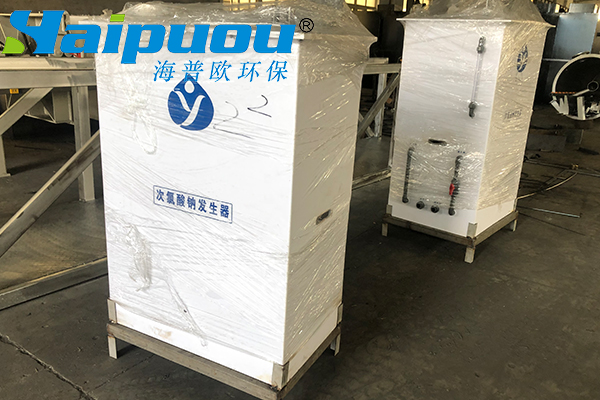
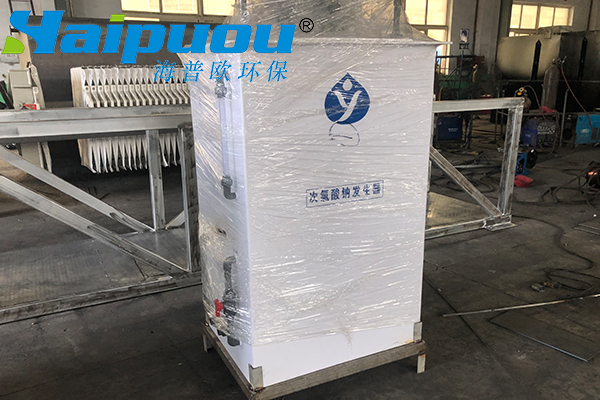
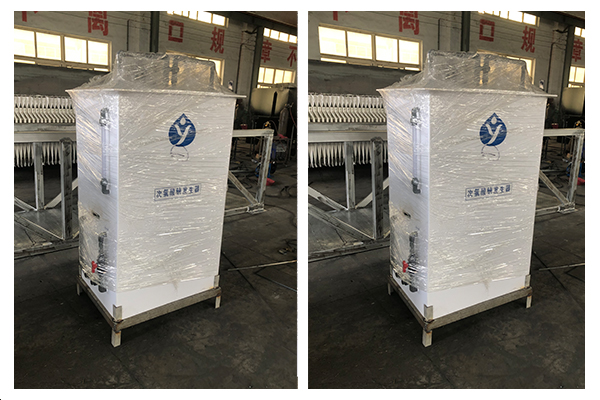
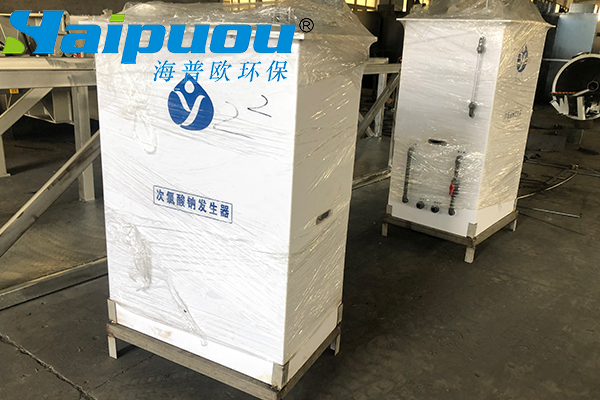
- The sodium hypochlorite generator consists of an electrolytic cell, a silicon rectifier electric control cabinet, a salt dissolving tank, a cooling system, and supporting components such as PUVC pipes, valves, water injectors, and flowmeters. A 3-4% dilute brine solution (Note: Supplemented with concentration unit "%" as "3~4" alone is ambiguous in the original text, which is a common concentration range for brine in such generators) is added to the electrolytic cell, and a 12V DC power supply is connected. By adjusting the electrolysis current, electrolysis is performed to produce sodium hypochlorite. The disinfectant solution is then delivered either by being absorbed and mixed by a water injector or by being metered through a metering pump and then mixed in a mixer for delivery.
Keywords:
Messages

Contact: +86 18016210178 (Ms.Liu)
Add:No.56, Donghuan Road, Zhucheng City, Weifang City, Shandong Province