


Intelligent APP-controlled integrated sewage treatment equipment
Category
零售价
市场价
重量
库存
隐藏域元素占位
- Overview
-
- Commodity name: Intelligent APP-controlled integrated sewage treatment equipment
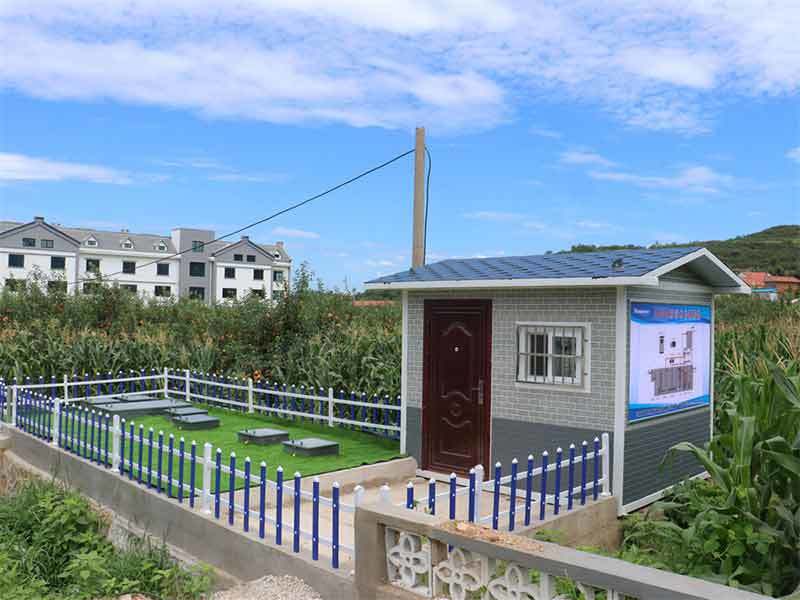
The integrated sewage treatment equipment is suitable for the treatment and reuse of domestic sewage and similar small-to-medium-sized industrial organic wastewater (such as that from slaughtering, aquatic product processing, and food industries) in residential quarters, villages, towns, office buildings, shopping malls, hotels, restaurants, sanatoriums, government agencies, schools, military camps, hospitals, expressways, railways, factories, mines, tourist attractions, and other locations. The quality of sewage treated by this equipment meets the Class 1 Grade B criteria in the National Integrated Wastewater Discharge Standard.
Advantages
- Strong resistance to shock loads: the average hydraulic retention time (HRT) of the contact oxidation process is more than 6 hours.
- Capable of nitrogen and phosphorus removal; moreover, by adjusting the equipment structure, it can treat industrial wastewater, domestic sewage, and municipal sewage.
- Most of the fillers in the contact oxidation tank are combined soft fillers, which feature light weight, high strength, stable physical and chemical properties, large specific surface area, strong biofilm adhesion capacity, and high contact efficiency between sewage and biofilm.
- Aerators are used in the contact oxidation tank for blast aeration, which keeps the fiber bundles floating continuously, ensures uniform aeration, and promotes the growth and maturation of microorganisms—exhibiting the characteristics of the activated sludge process.
- Stable effluent quality, low sludge production, and easy sludge treatment.
- Submersible pumps can be installed inside the equipment, reducing project investment.
- The equipment can be installed on the ground or buried underground. When buried underground, the upper surface can be used for greening, resulting in less floor space for the plant area and fewer ground structures.
- Easy to achieve automatic control, with simple management and operation.
- The equipment can be mounted on a vehicle to form a mobile integrated sewage treatment device.

Application Scope
The integrated sewage treatment equipment is suitable for the treatment and reuse of domestic sewage and similar small-to-medium-sized industrial organic wastewater (such as that from slaughtering, aquatic product processing, and food industries) in residential quarters, villages, towns, office buildings, shopping malls, hotels, restaurants, sanatoriums, government agencies, schools, military camps, hospitals, expressways, railways, factories, mines, tourist attractions, and other locations. The quality of sewage treated by this equipment meets the Class 1 Grade B criteria in the National Integrated Wastewater Discharge Standard.

Key Translation Notes
- Professional Term Accuracy: Industry-specific terms are translated in line with international standards, e.g., "抗冲击负荷" → "resistance to shock loads" (environmental engineering terminology), "接触氧化法" → "contact oxidation process" (standard name for the water treatment technology), "水力停留时间(HRT)" → "hydraulic retention time (HRT)" (abbreviation retained for conciseness, common in technical documents), "国家污水处理综合排放标准一级 B 标准" → "Class 1 Grade B criteria in the National Integrated Wastewater Discharge Standard" (official English name of China’s national sewage discharge standard).
- Logical Cohesion: Conjunctions like "moreover" and "resulting in" are added to clarify logical relationships between clauses (e.g., explaining the benefit of underground installation in Advantage 7), conforming to English expressive habits.
- Detail Preservation: Specific scenarios and material properties are accurately conveyed, e.g., "组合软填料" → "combined soft fillers" (precise description of the filler type), "纤维束" → "fiber bundles" (specific component of the filler), and the list of application locations (residential quarters, factories, etc.) is fully translated to cover all target scenarios.
- Conciseness & Clarity: Redundant repetitions in the original Chinese are optimized (e.g., merging duplicate "处理" into a single "treat" in Advantage 2), while ensuring no loss of information—making the translation concise yet comprehensive for technical communication.
Keywords:
Messages

Contact: +86 18016210178 (Ms.Liu)
Add:No.56, Donghuan Road, Zhucheng City, Weifang City, Shandong Province