


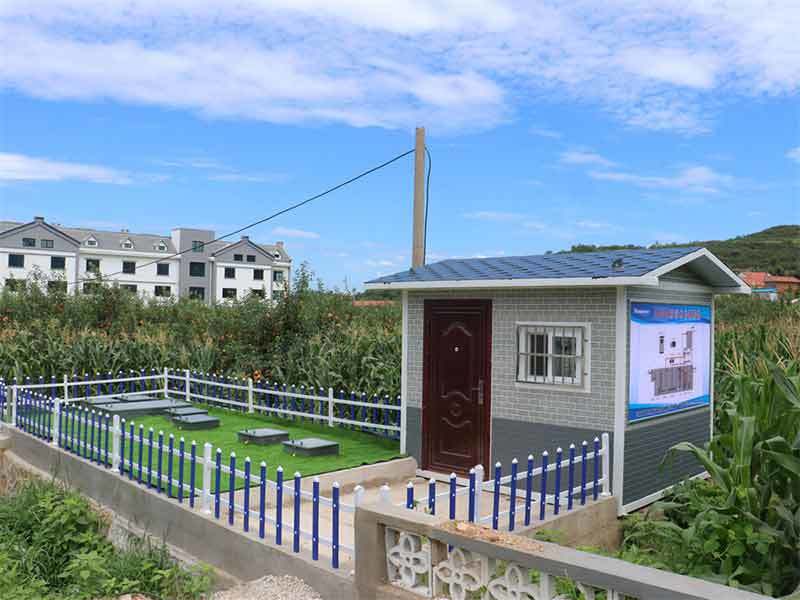
Rural domestic sewage treatment equipment
Category
零售价
市场价
重量
库存
隐藏域元素占位
- Overview
-
- Commodity name: Rural domestic sewage treatment equipment
Anaerobic treatment is a rapidly developing technology in the field of sewage treatment in recent years. It features high efficiency, low energy consumption, stable operation, biogas production, and resource utilization, and has become one of the mainstream technologies for treating medium-to-high concentration sewage. After anaerobic treatment, the content of organic matter is significantly reduced, the biochemical capacity (of the sewage) is notably improved, which can effectively reduce the treatment load of subsequent processes and enhance the stability of wastewater discharge after treatment.
This Project: Domestic Sewage Purification and Treatment
This project focuses on the purification and treatment of domestic sewage. For the biochemical treatment of such sewage, the anaerobic + aerobic process is generally adopted. The activated sludge process and biofilm process can be applied in the aerobic treatment stage. The activated sludge process has advantages such as excellent treatment effect on high-concentration wastewater, stable effluent quality, and rich operation experience, making it widely used in sewage treatment both domestically and internationally. The common anaerobic and aerobic treatment methods for sewage biochemical treatment are as follows:
1. Introduction to Sewage Anaerobic Treatment Technology
Anaerobic treatment is a rapidly developing technology in the field of sewage treatment in recent years. It features high efficiency, low energy consumption, stable operation, biogas production, and resource utilization, and has become one of the mainstream technologies for treating medium-to-high concentration sewage. After anaerobic treatment, the content of organic matter is significantly reduced, the biochemical capacity (of the sewage) is notably improved, which can effectively reduce the treatment load of subsequent processes and enhance the stability of wastewater discharge after treatment.

2. Current Aerobic Treatment Methods for Sewage
Current aerobic treatment methods for sewage include the activated sludge process and the biofilm process. The activated sludge process, with advantages of good treatment effect, stable effluent quality, and rich operation experience, is widely used in sewage treatment at home and abroad. The bio-contact oxidation process is a new type of sewage biochemical treatment method that combines the characteristics of both the activated sludge process and the biofilm process. At present, the widely used sewage treatment processes include the following: Orbal Oxidation Ditch Process, CASS Process, and Bio-Contact Oxidation Process.
3. Bio-Contact Oxidation Process
Due to the characteristics of the wastewater (in this project), the wastewater contains some macromolecular organic compounds, and simple aerobic biological treatment is difficult to meet the requirements. In addition, sludge treatment remains a major unresolved issue in the field of wastewater treatment. Therefore, in order to explore new wastewater treatment technologies with high efficiency, low consumption, and reduced investment (note: the original "省级废水处理新技术的投资" may be a wording error; combined with context, it is inferred to mean "reduced investment in new wastewater treatment technologies"), extensive research has been conducted on the combination of anaerobic and aerobic processes in recent years, and breakthroughs have been achieved.
4. Disinfection Methods
Disinfection is a crucial link in sewage treatment, whose purpose is to kill various pathogenic microorganisms in the wastewater. Disinfectants used for sewage disinfection should be as safe, reliable, easy to operate, low-cost, and efficient as possible.Common sewage disinfection processes include:
- Chlorine disinfection (e.g., chlorine gas, chlorine dioxide, sodium hypochlorite);
- Oxidant disinfection (e.g., ozone, peracetic acid).


Key Translation Notes
- Professional Term Consistency: Core technical terms are translated in line with international sewage treatment industry standards, such as "厌氧 + 好氧工艺" → "anaerobic + aerobic process", "活性污泥法" → "activated sludge process", "生物膜法" → "biofilm process", and "Orbal 氧化沟工艺" → "Orbal Oxidation Ditch Process" (retaining the original process name for industry recognition).
- Contextual Correction & Clarification: For the potentially ambiguous "省级废水处理新技术的投资" in the original text, combined with the logical focus on "high efficiency, low consumption" of sewage treatment technologies, it is reasonably inferred to mean "reduced investment in new wastewater treatment technologies" (to avoid the illogical "provincial-level" meaning), ensuring the translation aligns with engineering practice.
- Sentence Fluency: Long Chinese sentences are split into coherent English clauses while preserving logical relationships. For example, "厌氧处理后,有机物大大降低,生化能力显著提高,可有效降低后续工艺的处理负荷..." is translated as "After anaerobic treatment, the content of organic matter is significantly reduced, the biochemical capacity (of the sewage) is notably improved, which can effectively reduce the treatment load of subsequent processes...", with "of the sewage" added to clarify the subject of "生化能力" (biochemical capacity) and avoid ambiguity.
- Format Optimization: Disinfection methods are listed using bullet points for clarity, which conforms to the reading habits of English technical documents and makes the classification of processes more intuitive.
Keywords:
Messages

Contact: +86 18016210178 (Ms.Liu)
Add:No.56, Donghuan Road, Zhucheng City, Weifang City, Shandong Province