


- Overview
-
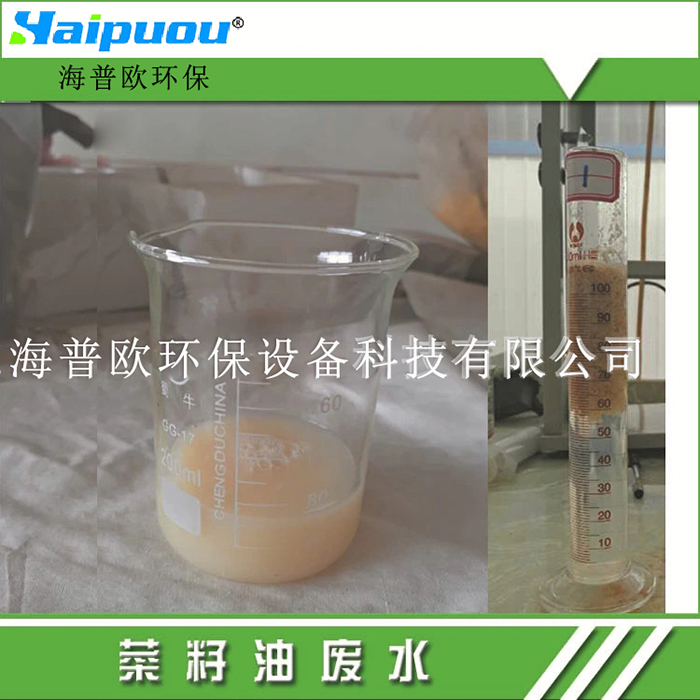
- Commodity name: Rapeseed oil wastewater
Oil in oily wastewater exists mainly in the forms of floating oil, dispersed oil, molten oil, and oil-solids.
(1) Floating oil: Floats on the water surface as a continuous phase, forming an oil film or layer. The oil droplets of this type are relatively large, generally greater than 100 μm.
(2) Dispersed oil: Suspended in water as tiny oil droplets, it is unstable and often becomes floating oil after standing for a certain period. Its droplet diameter is 10–100 μm.
(3) Emulsified oil: Water often contains surfactants that stabilize the oil into an emulsion. The oil droplet diameter is extremely small, generally less than 10 μm, with most being 0.1–2 μm.
(4) Dissolved oil: A dispersed oil that has been chemically dissolved. The oil droplet diameter is even finer than that of the emulsion, sometimes as small as a few nanometers. Oily wastewater treatment technologies can generally be categorized into physicochemical methods (mainly air flotation, membrane separation, adsorption, and coarse granulation), chemical methods (mainly chemical flocculation, chemical oxidation, and electrochemical methods), and biological treatment methods (mainly activated sludge and biological filters) based on their working principles and the types of oil removed. Each single purification method has its limitations. Depending on the wastewater composition and properties, the form of oil present, the depth of recovery and utilization, the discharge method, and environmental and economic requirements, several methods are usually rationally combined to form a multi-stage treatment process, thereby achieving good oil removal results and ensuring that the effluent quality meets wastewater discharge standards.
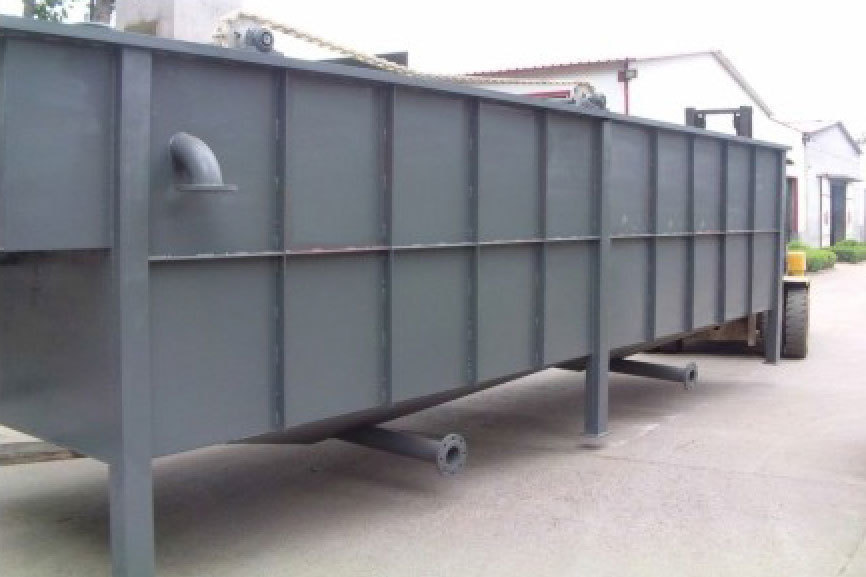
Air Flotation
Air flotation technology is a widely used water treatment technology for oily wastewater both domestically and internationally. Its principle involves introducing air or other gases into the water to generate microbubbles. Small suspended oil droplets and solid particles in the water adhere to these bubbles and float to the surface, forming scum, thus completing the separation process.
Air FlotationAir flotation technology is a widely used water treatment technology for oily wastewater both domestically and internationally. Its principle is to introduce air or other gases into the water to generate microbubbles. Small suspended oil droplets and solid particles in the water adhere to these bubbles and float to the surface, forming scum, thus completing the separation process. Membrane Separation
Membrane separation is a novel separation technology that has developed rapidly in the last 20 years. Traditional methods for treating emulsified oily wastewater often involve preliminary demulsification processes such as electrolysis and flocculation, resulting in high energy and material consumption. Membrane separation, however, generally eliminates the need for demulsification, achieving direct oil-water separation. Furthermore, it does not produce oily sludge, and the concentrate can be incinerated. The treatment capacity and water quality are relatively stable, unaffected by fluctuations in the oil concentration in the influent. Generally, only a pressure circulating water pump is required, leading to low equipment and operating costs, making it particularly suitable for treating high-concentration emulsified oily wastewater. The key to successful oil removal using membrane separation lies in the selection of the membrane. Currently, membranes used for oil-water separation are typically reverse osmosis, ultrafiltration, and microfiltration membranes, which function to retain emulsified and dissolved oils.
Keywords:
Messages

Contact: +86 18016210178 (Ms.Liu)
Add:No.56, Donghuan Road, Zhucheng City, Weifang City, Shandong Province