

News details
Industrial Sewage Treatment Equipment: Core Environmental Protection Equipment for Enterprises' Green Production
Release time:
2025-12-11 16:26
I. The Importance of Industrial Sewage Treatment Equipment
Industrial production processes generate a large amount of wastewater containing pollutants such as organic substances, heavy metals, and suspended solids. Direct discharge of such wastewater will cause severe pollution to soil, water bodies, and the atmospheric environment, endangering ecological balance and human health. Through various physical, chemical, and biological treatment technologies, industrial sewage treatment equipment removes or converts pollutants in wastewater into harmless substances, ensuring that the treated water quality meets national or local discharge standards. This not only helps enterprises comply with environmental protection regulations and avoid risks such as fines and production suspension due to pollution issues but also reduces water resource waste, realizes water recycling, and lowers enterprises' production costs.
II. Main Types and Working Principles of Industrial Sewage Treatment Equipment
(I) Physical Treatment Equipment
Physical treatment equipment mainly separates and removes suspended solids, colloids, and other pollutants in wastewater through physical actions. Common types include grilles, grit chambers, sedimentation tanks, and filtration equipment.
- Grilles: As the first process of sewage treatment, grilles are used to remove large solid debris in wastewater, such as branches, plastic bags, and fibers, preventing these debris from clogging subsequent equipment. Their working principle is to intercept solid particles larger than the gap size using the gaps between grille bars.
- Grit Chambers: Primarily remove inorganic particles such as sand and gravel from wastewater. When wastewater enters the grit chamber, the flow velocity decreases, and particles like sand settle at the bottom under the action of gravity, which are then discharged through sand scraping equipment.
- Sedimentation Tanks: Used to remove suspended solids and colloids in wastewater. According to the water flow direction and tank structure, sedimentation tanks can be divided into horizontal flow, vertical flow, and radial flow types. Suspended particles in wastewater settle at the bottom to form sludge under gravity, while the upper clear water is discharged through overflow outlets.
- Filtration Equipment: Such as sand filters and activated carbon filters, which further remove fine suspended solids and organic substances in wastewater through the interception effect of filter media. Sand filters use quartz sand as the filter medium, while activated carbon filters utilize the adsorption performance of activated carbon to remove odors, pigments, and some organic substances from wastewater.
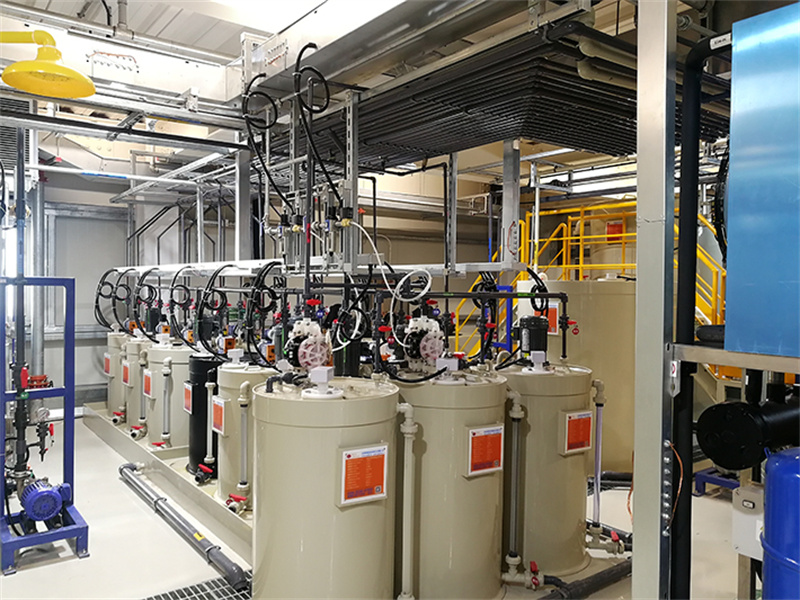
(II) Chemical Treatment Equipment
Chemical treatment equipment achieves water purification by adding chemical agents to wastewater, causing chemical reactions with pollutants to form easily separable substances. Common chemical treatment equipment includes neutralization tanks, coagulation tanks, and redox equipment.
- Neutralization Tanks: Used to treat acidic or alkaline wastewater. By adding alkaline or acidic agents to wastewater, the pH value is adjusted to neutral or near-neutral, facilitating subsequent treatment.
- Coagulation Tanks: Coagulants and flocculants are added to wastewater to make colloidal and suspended particles aggregate into large flocs, which are then removed through sedimentation tanks or filtration equipment. Common coagulants include aluminum sulfate and ferric chloride, while flocculants include polyacrylamide.
- Redox Equipment: Converts harmful substances in wastewater into harmless ones using redox reactions. For example, when treating cyanide-containing wastewater, oxidants such as sodium hypochlorite can be added to oxidize and decompose cyanide into carbon dioxide and nitrogen.
(III) Biological Treatment Equipment
Biological treatment equipment utilizes the metabolic activities of microorganisms to decompose organic substances in wastewater into inorganic substances, realizing sewage purification. According to the living mode of microorganisms, biological treatment equipment can be divided into aerobic biological treatment equipment and anaerobic biological treatment equipment.
- Aerobic Biological Treatment Equipment: Such as activated sludge process and biofilm process. The activated sludge process involves introducing air into the aeration tank to fully mix sewage with activated sludge, where microorganisms in the activated sludge decompose organic substances in sewage under aerobic conditions. The biofilm process forms a biofilm on the carrier surface, with microorganisms attaching to the biofilm and metabolizing and reproducing using organic substances in sewage to achieve sewage purification.
- Anaerobic Biological Treatment Equipment: Such as anaerobic reactors. Under anaerobic conditions, anaerobic microorganisms decompose organic substances in sewage into gases such as methane and carbon dioxide, realizing sewage treatment and energy recovery. Anaerobic biological treatment equipment is suitable for treating high-concentration organic wastewater, such as wastewater from food processing and brewing industries.
III. Key Selection Factors for Industrial Sewage Treatment Equipment
Enterprises need to comprehensively consider multiple factors when selecting industrial sewage treatment equipment to ensure the treatment effect, operational stability, and economy of the equipment.
(I) Sewage Quality and Quantity
Industrial wastewater quality varies significantly across different industries. For example, chemical wastewater contains high concentrations of organic substances and heavy metals, while papermaking wastewater contains a large amount of suspended solids and lignin. Therefore, enterprises need to first conduct water quality testing on their self-generated sewage to understand indicators such as pollutant types, concentrations, and pH values. At the same time, they should consider the sewage volume, including average daily discharge and maximum daily discharge, to determine the treatment capacity of the equipment.
(II) Treatment Requirements and Discharge Standards
Enterprises need to determine the water quality requirements of treated sewage based on national or local environmental protection regulations and discharge standards. For example, some regions have strict restrictions on indicators such as COD, ammonia nitrogen, and total phosphorus in industrial wastewater, and enterprises need to select sewage treatment equipment that can meet these indicator requirements.
(III) Equipment Reliability and Stability
Industrial sewage treatment equipment needs to operate continuously for a long time, so the reliability and stability of the equipment are crucial. When selecting equipment, enterprises should prioritize products with reliable quality and stable performance, check indicators such as operating parameters, service life, and maintenance cycles of the equipment, and understand the after-sales service quality of the manufacturer to ensure timely maintenance and replacement when equipment failures occur.
(IV) Operating Costs and Investment Costs
Operating costs include electricity fees, water fees, chemical agent fees, and labor costs, while investment costs include equipment purchase fees, installation and commissioning fees, and floor space. Enterprises need to comprehensively consider the operating costs and investment costs of the equipment and select cost-effective equipment. For example, for high-concentration organic wastewater, anaerobic biological treatment equipment has relatively low operating costs but high investment costs, while aerobic biological treatment equipment has relatively low investment costs but high operating costs.
(V) Floor Space and Installation Conditions
The floor space and installation conditions of industrial sewage treatment equipment are also factors that enterprises need to consider when selecting equipment. For enterprises with limited floor space, compact sewage treatment equipment can be selected; for locations with limited installation space, equipment that is easy to install and maintain should be chosen.
IV. Development Trends of Industrial Sewage Treatment Equipment
With the continuous improvement of environmental awareness and the increasing stringency of environmental protection regulations, the industrial sewage treatment equipment industry is developing towards intelligence, high efficiency, energy conservation, and modularization.
(I) Intelligence
Using technologies such as the Internet of Things (IoT), big data, and artificial intelligence to realize remote monitoring, automatic control, and intelligent diagnosis of industrial sewage treatment equipment. By installing sensors and monitoring equipment, real-time collection of equipment operating parameters and sewage quality data is conducted, which is uploaded to the cloud platform. Managers can check the equipment operating status anytime and anywhere through mobile phones or computers, and promptly detect and solve problems. At the same time, the intelligent control system can automatically adjust equipment operating parameters according to changes in sewage quality and quantity, improving treatment effect and operational efficiency.
(II) High Efficiency
Developing and applying efficient sewage treatment technologies and equipment to improve sewage treatment efficiency and pollutant removal rate. For example, new membrane separation technologies and advanced oxidation technologies can effectively remove refractory organic substances and heavy metals in wastewater, raising the standards of treated water quality.
(III) Energy Conservation
Reducing the energy consumption of industrial sewage treatment equipment is an important development direction in the future. Energy consumption can be reduced by adopting energy-saving motors, optimizing equipment operating processes, and recycling energy in sewage. For example, in anaerobic biological treatment equipment, methane gas is recovered as energy to achieve self-sufficiency in energy.
(IV) Modularization
Designing industrial sewage treatment equipment into a modular structure to facilitate enterprises to combine and expand according to their own needs. Modular equipment has the advantages of easy installation, small floor space, and simple maintenance, and can adapt to the sewage treatment needs of enterprises of different scales.
V. Conclusion
Industrial sewage treatment equipment is an important guarantee for enterprises to achieve green production, and it is of great significance for protecting the environment, saving resources, and enhancing enterprise competitiveness. When selecting industrial sewage treatment equipment, enterprises should comprehensively consider indicators such as equipment reliability, stability, operating costs, and investment costs based on their own sewage quality, quantity, treatment requirements, and other factors, and choose suitable sewage treatment equipment. At the same time, with the continuous progress of science and technology, industrial sewage treatment equipment will continue to develop towards intelligence, high efficiency, energy conservation, and modularization, providing stronger support for the sustainable development of enterprises.
Related news


Contact: +86 18016210178 (Ms.Liu)
Add:No.56, Donghuan Road, Zhucheng City, Weifang City, Shandong Province